

Location Analytics for sharper Law Enforcement

Updated: Dec 13, 2025
There is a certain charm in solving a crime—from inspecting the incident site and investigating suspects to uncovering the motive and identifying the culprit. People of all ages enjoy the unraveling of mysteries in novels and movies. While such content is often fictional, the addition of “based on a true story” increases the thrill quotient by several notches.
What if such a story were narrated by the real-life protagonist? Wouldn’t that be doubly fascinating? If your answer is in the affirmative, you are likely to enjoy this TEDx Talk by IPS Amit Lodha:
All crimes—except cybercrimes—occur at physical locations. And anything that involves positional information can be mapped, analyzed, and interpreted to reveal valuable insights. Modern mapping technology—Geographic Information Systems (GIS)—is widely used across several Law Enforcement workflows, four of which I will demonstrate in this post.
SECTION HYPERLINKS
1. Coverage Mapping of Police Stations to ensure Rapid Response
GIS-based Location Analytics helps Law Enforcement agencies plot and interpret historical crime data and make informed decisions regarding resource allocation. The map below depicts all recorded crime locations and police station locations in a city comprising five districts over a period of time.

Using geoprocessing tools within an online GIS platform, I prepared a map (Figure 2) depicting zones in the city that are within rapid reach of the police station network. The pink-shaded areas are reachable within five minutes of driving from a police station. While this analysis accounts for the city’s road network, traffic conditions can also be integrated into the drive-time computation if such datasets are available.

This analysis reveals that 922 out of 1,025 historical crime sites (black dots) fall within the 5-minute drive-time zone—indicating a rapid response coverage of approximately 90%, assuming historical crime locations serve as a reasonable proxy for future incidents. That said, several areas within Lincoln’s city limits (outlined in black) remain outside this rapid-response coverage. The fact that crimes have not occurred frequently in these zones is a separate consideration altogether.
A heat map of historical crime sites (Figure 3) helps identify areas with a high density of crime.

Overlaying the heat map with the rapid response layer (Figure 4) allows one to pinpoint priority areas requiring immediate attention. The blue zones along the eastern fringes of Lincoln city emerge as strong candidates for setting up new police stations.

This analysis can be refined further on the GIS platform—for instance, determining the minimum number of new police stations required and identifying their optimal locations to maximize coverage of underserved areas. Optimization and network modelling capabilities are integral to modern Location Analytics platforms.
2. Map-based Operations Dashboard to monitor Crime
In the previous workflow, crime records were not categorized by severity. Incorporating severity levels enhances analytical depth.
Clicking on Figure 5 directs you to a GIS-based Crime Dashboard maintained by the Yakima Police Department (USA). The dashboard is dynamic and allows users to visualize historical crime data across multiple categories and time horizons. I recommend exploring it using the available filters and navigation tools.


As depicted in Figure 6, live video feeds—from CCTV cameras, drones, or other surveillance devices—can also be integrated into such dashboards, significantly enhancing their operational value. For decision-makers within Law Enforcement, GIS not only aids in understanding historical crime patterns but also supports real-time monitoring of policing operations and anticipation of future scenarios.
3. Innocuous Medical Prescriptions or a Deadly Drug-Trafficking Ring?
Unearthing a drug-trafficking ring by analyzing hundreds of seemingly innocuous medical prescriptions may sound far-fetched—but advanced Location Analytics makes this possible.
The video below demonstrates how Law Enforcement agencies can detect sophisticated criminal activity by performing spatial analysis on prescription records.
The geoprocessing showcased in the video was performed using ArcGIS Insights, an advanced Location Analytics module.
4. Analyzing Cell Tower Records to isolate Suspects
In his TEDx Talk, IPS Amit Lodha describes how monitoring a criminal’s phone location helped triangulate and apprehend him. Now consider a more complex scenario—where Law Enforcement does not know the identity of the criminal and must sift through massive volumes of telecom data to detect patterns and isolate suspects.
GIS platforms are well-suited to handle such scale. Figure 7 depicts 1.28 million cellular location records belonging to nearly 2,500 mobile phone users, collected over 45 days from telecom towers.
Law Enforcement believes the crime syndicate is operating from three zones in the city (denoted by violet boxes). The objective is to identify individuals who have visited all three zones within the specified time frame.


At first glance, navigating such vast datasets may seem daunting. However, GIS offers efficient ways to suppress noise and emphasize meaningful patterns.
Figure 9 presents a chart generated within the desktop GIS software, depicting users who have visited two or more of the suspected crime zones over the last 45 days.
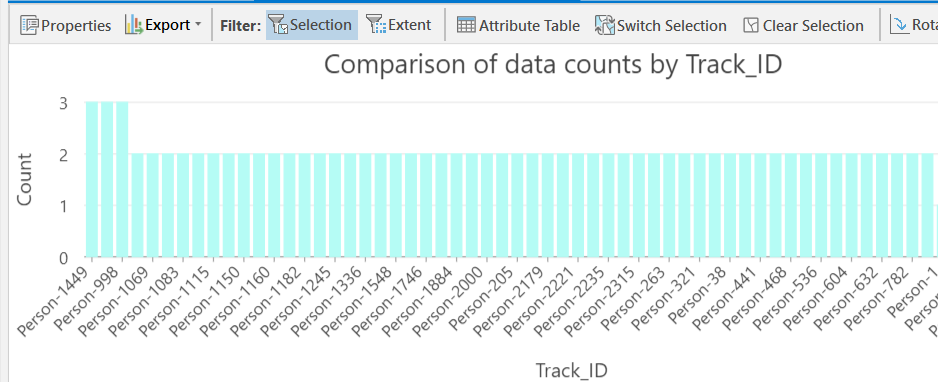

Law Enforcement then uses the Select by Attributes geoprocessing tool (Figure 10) to narrow the analysis to a few individuals of interest.

More importantly, investigators now analyze these spatial records through time.
While spatial data alone is powerful, incorporating the temporal dimension elevates the analysis significantly. Spatiotemporal analysis builds upon traditional spatial analysis—something I have also demonstrated in a separate post analyzing vehicle accident records to identify road sections prone to safety risks.
CONCLUSION
Because crime-related Location Analytics is a specialized domain, several geoprocessing tools have been custom-built for practitioners and are bundled as add-on modules within GIS platforms. One such solution is highlighted in the StoryMap linked below.

You have seen how GIS enables Law Enforcement agencies to analyze spatial and temporal data to track, monitor, and prevent crime. To close, here is an interesting case study demonstrating how Location Intelligence enhances situational awareness during large public events:
Reach out to us with your Location Analytics requirements.
ABOUT US - OPERATIONS MAPPING SOLUTIONS FOR ORGANIZATIONS
Intelloc Mapping Services, Kolkata | Mapmyops.com offers a suite of Mapping and Analytics solutions that seamlessly integrate with Operations Planning, Design, and Audit workflows. Our capabilities include — but are not limited to — Drone Services, Location Analytics & GIS Applications, Satellite Imagery Analytics, Supply Chain Network Design, Subsurface Mapping and Wastewater Treatment. Projects are executed pan-India, delivering actionable insights and operational efficiency across sectors.
My firm's services can be split into two categories - Geographic Mapping and Operations Mapping. Our range of offerings are listed in the infographic below-

A majority of our Mapping for Operations-themed workflows (50+) can be accessed from this website's landing page. We respond well to documented queries/requirements. Demonstrations/PoC can be facilitated, on a paid-basis. Looking forward to being of service.
Regards,


