

Was relocating the IPL to UAE in 2020 the best choice?

Updated: Dec 8, 2025
Due to rising coronavirus cases, the Government deemed it too risky to allow the 2020 edition of the Indian Premier League—cricket’s biggest commercial spectacle—to be held domestically. On 10th August, the BCCI received approval from the Central Government to relocate the 13th IPL season to the United Arab Emirates.
This naturally raises the question: Why did the BCCI choose the UAE? Were there no viable alternatives within India or in India’s neighbourhood?
This was not the first relocation—IPL was played in South Africa (2009) and the UAE (2014) when general elections prevented the government from allocating security resources to a tournament spread across eight or more venues.
Since siting and location analytics are subjects I am passionate about, I was curious to see what a structured, GIS-based approach would reveal about the suitability of the UAE vis-à-vis other potential host locations. Before diving in, pause for a moment and think of which venues—within India or overseas—could have been feasible replacements for the Sharjah–Dubai–Abu Dhabi trio.
Shifting IPL to a location outside Asia - be it South Africa, Australia or England - was never seriously considered. The logistical challenges of long-haul travel, stringent quarantine rules during the pandemic, and extremely high operational costs—compounded by the absence of ticketing revenue—made these options impractical.
My surmises that India, with its large pool of cricket stadiums, ought to have been able to host the league safely by selecting a cluster of low-risk locations close to each other.
As is often the case, my initial assumption was way off the mark - India had only 23 active international cricket stadiums that were operational, equipped with floodlights, and certified by the International Cricket Council (ICC)—in other words, venues with adequate infrastructure and amenities. Twenty-three is not a small number; in fact, it is the highest count for any cricket-playing nation. Yet, given the sport’s popularity and the country’s vast geography, I had assumed we would have at least fifty. Even with twenty-three, I still felt we might be able to identify a suitable cluster of venues.
Note: The GIS application I prepared for this study can be accessed here (2024 update: the application has expired). You could navigate it alongside this post, as several aspects become clearer when viewed directly on the map. Some of the images shown here may not fully convey the detail of the original application.
What parameters did I choose for shortlisting the suitable combination of venues within India?
The answer was straightforward: the location characteristics of any shortlisted combination should be at least as favourable—preferably better—than what the UAE offered the BCCI.

The UAE is geographically small, and it had offered three cricket stadiums located in close proximity to one another - likely the central factor that swayed the BCCI: scheduling matches and managing logistics for the eight participating teams (with up to four teams playing each day) becomes far simpler when the venues are clustered together.
Modern Location Analytics platforms (GIS) are extremely powerful. Instead of relying on straight-line (Euclidean) distances to assess stadium proximity, I used the Create Drive Time Areas geoprocessing tool to compute the actual driving-distance coverage from Sharjah—one end of the UAE stadium trio—within a two-hour time window. This tool can be configured to account for factors such as road networks, vehicle speed, time of day, and even live traffic conditions.

In the visual above, you can see the area reachable by car within two hours from Sharjah Stadium. Notably, Abu Dhabi Stadium—the most distant of the three—is still just within the two-hour drive-time threshold. Road connectivity between these venues is excellent, and barring unexpected traffic issues, this travel window is highly practical for scheduling. In fact, teams could even be based in Dubai and still reach any of the three venues in roughly 90 minutes or less.
As I reflected on the location dynamics (having lived in the UAE for four months), it became increasingly clear why the country appealed to the BCCI: shorter travel times, fewer touchpoints (no flights or trains—only team buses or cars, reducing transmission risk), luxury accommodation, and state-of-the-art training facilities. All these factors collectively suggested that creating a strong bio-secure bubble would be far more feasible in the UAE—an aspect the BCCI was deeply invested in for the safety of the travelling contingent.
“Hang on,” I said to myself, “can’t we find something similar in India—venues where the drive time is just as convenient, if not better, than what the UAE offered?”.
With that thought, I loaded the data for all Active International Cricket Stadiums in India onto the mapping application. It quickly became apparent that most stadiums were geographically dispersed.

When I ran the Create Drive Time Areas tool using the same two-hour parameter applied to the UAE venues, the output was revealing-

Fair to say, the results were not encouraging—no combination of three stadiums fell within a two-hour drive-time window.
At best, only three pairs of stadiums met the criterion: Mumbai’s Wankhede and Brabourne stadiums, Delhi and Greater Noida, and Lucknow and Kanpur. The closest three-stadium combination would be Wankhede, Brabourne, and Pune’s MCA Stadium. However, reaching MCA Stadium from South Mumbai takes more than three hours.
And in case you’re wondering, DY Patil Stadium in Navi Mumbai in Navi Mumbai had been converted into a football venue (as of 2020) and therefore did not qualify as an Active International Cricket Stadium. If only it had been available—Mumbai (2) + Navi Mumbai (1) would have been the perfect trio and would comfortably have met the two-hour drive-time requirement!
October 2024 Update: I happened to stay at a hotel right behind DY Patil Stadium recently, and judging by its current state, it seems to have been converted back into a cricket stadium! Wikipedia even notes that football matches are now held only occasionally, and that the stadium hosted several IPL matches in 2022.
If only it had been available in 2020… 😢

I continued to grapple with the problem purely from a proximity standpoint. Could other countries within Asia present viable alternatives?
Pakistan was obviously not an option India would consider, so Bangladesh and Sri Lanka remained the only plausible choices by virtue of being Test-playing nations. Given that both are geographically small, I felt there was a higher likelihood of finding three stadiums situated conveniently close to one another.
As it turned out, Bangladesh had four Active International Cricket Stadiums equipped with floodlights—meaning they could host matches during the preferred evening hours. Unfortunately, even here, no combination of three venues fell within the two-hour drive-time window. The best result was a pair: Dhaka and Fatullah, both located within the Dhaka administrative division. The other two venues—Chittagong and Sylhet—were far less convenient, lying roughly 4–6 hours away by road from Dhaka.

By virtue of being one of the world's most densely populated countries, I felt BCCI would have been reluctant to consider Bangladesh even if it had satisfied the proximity criterion.
With that in mind, I turned—somewhat hopefully—to analysing the prospects of hosting the IPL in Sri Lanka. The island nation also has four Active International Cricket Stadiums with floodlights as of 2020.
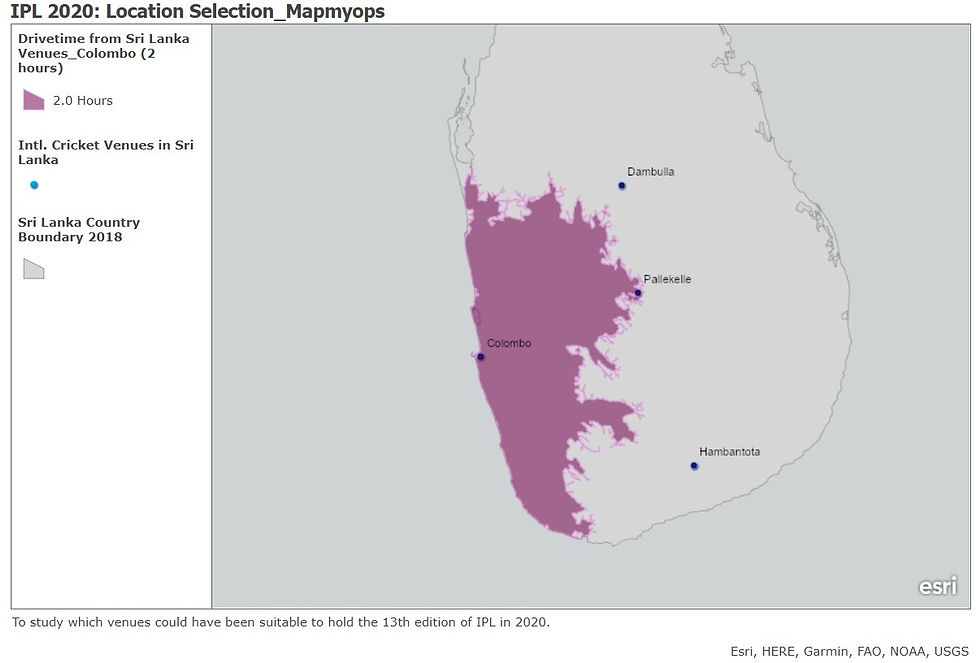
Close! Although not exactly within the two-hours drive time window, the combination of Colombo, Pallekelle and Dambulla is a compelling proposition!
To refine the analysis further, I began gathering cumulative Coronavirus case data as of 20th September 2020—this would serve as my second (and final) parameter for comparing the potential host countries. By linking this non-geospatial dataset to each stadium’s coordinates, I could convert it into geospatial data and analyze it within my GIS software.
City-level cumulative case data, however, was not available consistently across all venues. As a result, I broadened the aggregation to the Administrative Region level. This is what I was able to compile:
India — State-level
Bangladesh — Division-level
Sri Lanka — Country-level
UAE — Country-level
I then estimated the cumulative Coronavirus cases to be associated with each stadium based on the population share of the city (housing the venue) relative to the population of its Administrative Region. For example: if Maharashtra reported 100 cumulative cases and Pune—home to the MCA International Stadium—accounts for 20% of Maharashtra's population, I assumed Pune would have 20 cumulative cases, and mapped this value to the MCA Stadium in the GIS.
The resulting output across all venues is shown below—

What can you infer?
I can tell you I was genuinely surprised when I interpreted the output for the first time.
While the total cumulative Coronavirus cases in the UAE appeared relatively modest at around 85,000, the proportion of population affected was actually very high—nearly 1 in every 100 residents had been infected at some point. In fact, most of Eastern India, Bangladesh, and Sri Lanka fared better than the UAE on this parameter (though one could reasonably argue that India’s figures were understated due to lower testing rates and possible under-reporting).
Naturally, I was keen to see how the Mumbai(2)–Pune(1) combination compared. Unfortunately, it fared even worse than the UAE, as reflected by its darker shade of red in Figure 8 above.
That being said, the combination of Dehradun, Dharamshala and Mohali emerged as the most appealing alternative from a virus-cases standpoint. However, the Himalayan foothills present their own logistical challenges—narrow, winding terrain that becomes particularly difficult to navigate at night once matches conclude, and even more so with foggy winter approaching.
The three-stadium cluster in Uttar Pradesh (Delhi, Lucknow and Kanpur) performs better on proximity and is reasonably positioned in terms of virus cases, yet it is easy to see why it might not be preferred—UP’s population density is nearly three times the national average, which itself is already very high. The same density-related concern applies to Bangladesh, even though its cumulative cases relative to population are (surprisingly) lower than those of the UAE.
Which brings me back to Sri Lanka…

Sri Lanka’s cumulative Coronavirus caseload was very low—3,287 cases as of 20th September 2020, with only 186 active cases. This translates to just 0.02% of the country's population. Add to this a pristine, isolated geography, excellent tourism infrastructure, and favourable timing (winter is the ideal season for cricket in this tropical nation), and Sri Lanka—particularly the trio of Dambulla, Pallekelle, and Colombo—stands out as a compelling alternative to the UAE. The attractive INR/LKR exchange rate (1:2.52) would also reduce operational costs.
This trio certainly seems a very compelling alternative to me - perhaps, even better than UAE. In fact, Sri Lanka actually even offered to host the IPL as early as April this year.
So why didn’t the BCCI accept?
In my view, two factors likely weighed heavily:
a) Ongoing corruption allegations involving the Sri Lankan Cricket Board, and
b) A lingering security threat following the recent terrorist attacks

How did you find this exploratory study?
The methodology can certainly be refined further for a more rigorous analysis. Additional parameters such as active Coronavirus cases, projected rise in infections, quality and availability of hotels, location-wise operational costs, and even weather forecasts could be incorporated to strengthen the evaluation.
One key insight I gained through this study is the advantage of having sporting venues located in close proximity to one another. It dramatically simplifies the logistics of organizing large competitions and global tournaments such as the IPL. This is precisely why host countries for mega-events like the Olympic Games build extensive, centralized sporting villages—to minimize movement, reduce complexity, and streamline operations.
India, in contrast, follows a highly dispersed model where each state develops one or two cricket stadiums—often as a political gesture rather than a logistical strategy. This means tournaments inevitably sprawl across vast distances, exposing athletes, support staff, media teams and officials to significant and often unnecessary travel. From a time, comfort and cost perspective, it simply does not make sense—especially when compared to the benefits of a compact tournament footprint (refer to this article also highlights these advantages)
2025 update: I was delighted to know (and pleased to visit it too!) that the entire Hockey India League 2024–25 was hosted at the magnificent, newly-constructed Birsa Munda International Hockey Stadium in Rourkela—a welcome departure from the usual dispersed format.
ABOUT US - OPERATIONS MAPPING SOLUTIONS FOR ORGANIZATIONS
Intelloc Mapping Services, Kolkata | Mapmyops.com offers a suite of Mapping and Analytics solutions that seamlessly integrate with Operations Planning, Design, and Audit workflows. Our capabilities include — but are not limited to — Drone Services, Location Analytics & GIS Applications, Satellite Imagery Analytics, Supply Chain Network Design, Subsurface Mapping and Wastewater Treatment. Projects are executed pan-India, delivering actionable insights and operational efficiency across sectors.
My firm's services can be split into two categories - Geographic Mapping and Operations Mapping. Our range of offerings are listed in the infographic below-

A majority of our Mapping for Operations-themed workflows (50+) can be accessed from this website's landing page. We respond well to documented queries/requirements. Demonstrations/PoC can be facilitated, on a paid-basis. Looking forward to being of service.
Regards,


